



How Contact Centres Reduce Churn Risk in Subscription-Based Business Models
Subscription businesses do not lose customers in dramatic moments. Churn builds quietly. A delayed onboarding step, a billing error that takes too long to resolve, a downgrade handled poorly, or a cancellation request that reveals unresolved friction. Each issue may look small in isolation, but together they create predictable revenue leakage over time.
In Australian subscription markets, where long-term contracts and recurring billing models are common across sectors such as utilities, software, and financial services, churn is not just a customer experience concern. It is a financial risk that compounds month after month. An Australian contact centre sits at the centre of this risk because it handles the lifecycle moments where churn probability increases long before a cancellation is confirmed.
Why Churn Behaves Differently in Subscription-Based Models
In transactional businesses, churn often follows a single failed interaction or a better competing offer. In subscription businesses, churn develops through accumulation. Customers may remain active while disengaging, reducing usage, delaying payments, or downgrading plans. Revenue loss often begins before the customer formally leaves.
This makes churn harder to detect and harder to reverse. It also means that service failures early in the relationship carry disproportionate financial impact. A poorly supported first month can shorten customer lifetime value even if the customer stays for several billing cycles.
Because revenue depends on continuity rather than volume, subscription businesses must treat churn as a structural risk. Contact centres are one of the few operational functions that interact with customers across the entire lifecycle, which gives them a unique role in identifying and reducing churn exposure.
Where Churn Risk Emerges Across the Subscription Lifecycle
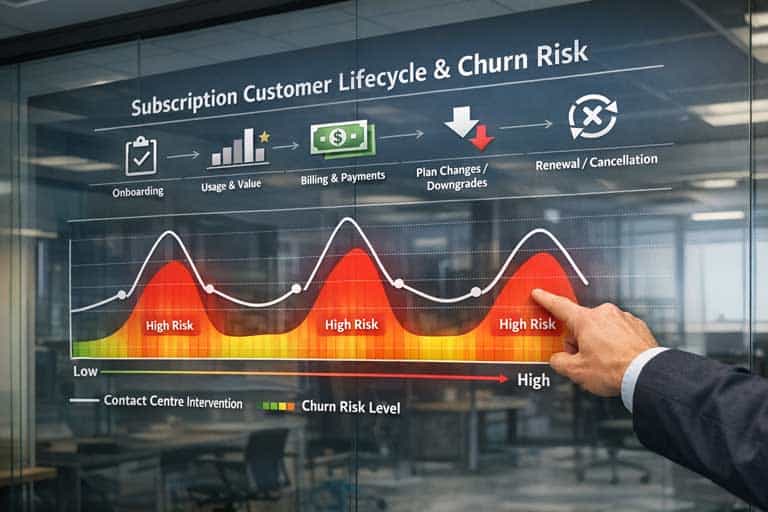
Churn risk does not appear evenly. It clusters around specific lifecycle moments where customers reassess value, effort, or trust.
The earliest risk point occurs during onboarding. Customers who struggle to activate services or understand how to use them often disengage silently. Billing events introduce another major risk point. Failed payments, unclear charges, or slow dispute resolution can trigger frustration even when the underlying service is valued.
Plan changes create further exposure. Upgrade requests, downgrades, pauses, and temporary suspensions all signal changes in customer commitment. Cancellation requests are the final signal, but by that point churn risk has often existed for weeks or months.
Contact centres that understand these lifecycle patterns can intervene earlier, reducing the likelihood that small issues accumulate into irreversible churn.
The Contact Centre as a Revenue Protection Function, Not a Support Channel
In many organisations, contact centres are measured primarily on responsiveness and resolution speed. While these metrics matter, they do not fully capture the contact centre’s role in subscription businesses.
Each interaction represents a decision point that can either stabilise or destabilise recurring revenue. When agents are equipped to handle lifecycle events accurately and consistently, the contact centre becomes a revenue protection layer rather than a reactive service desk.
This requires a shift in mindset. The goal is not only to solve the immediate issue but to preserve continuity. That means understanding the downstream impact of how billing issues are resolved, how plan changes are explained, and how cancellation intent is handled.
Onboarding Failures and Early-Stage Churn Risk
The first interactions a subscriber has with a contact centre often occur during onboarding. Questions about setup, access, or usage are common. When these interactions are slow, inconsistent, or fragmented, customers may proceed with incomplete understanding of the service.
Early-stage churn is particularly damaging because it shortens lifetime value dramatically. A customer who leaves after three months represents a very different financial outcome to one who leaves after three years, even if the immediate issue appears identical.
Contact centres reduce early churn risk by ensuring onboarding support is accurate, timely, and consistent. This includes clear handovers from sales, structured onboarding scripts, and escalation paths that resolve setup issues before frustration becomes disengagement.
Billing, Payments, and Service Continuity Failures
Billing-related interactions are among the highest risk churn moments in subscription businesses. Failed payments, card updates, disputed charges, and account suspensions often occur outside normal service usage patterns, which makes them particularly disruptive.
When billing issues are handled poorly, customers may question trust rather than value. Confusion about charges or delays in restoring access can create the perception that the service is unreliable, even if the core offering remains strong.
Contact centres play a critical role in maintaining service continuity during billing disruptions. Clear explanations, fast resolution, and accurate account handling reduce the likelihood that billing friction leads to cancellation.
Plan Changes, Pauses, and Downgrade Conversations
Not all churn signals indicate dissatisfaction. Many customers request downgrades or pauses due to changing needs, budget cycles, or temporary circumstances. How these requests are handled influences long-term retention.
A rigid or transactional response can push customers toward cancellation. A structured conversation that acknowledges the request while preserving optionality can keep customers engaged for longer, even at a lower short-term revenue level.
Contact centres that treat plan changes as lifecycle management rather than loss prevention can reduce churn risk while maintaining trust.
Cancellation Intent as a Signal, Not an Endpoint
By the time a customer requests cancellation, churn risk has already materialised. However, cancellation interactions still provide valuable insight into systemic issues.
Contact centres that capture structured data from cancellation requests can identify patterns across cohorts, products, or lifecycle stages. This information is more valuable than generic satisfaction scores because it reveals where operational friction is accumulating.
The goal is not to prevent every cancellation but to understand why customers reach that point and how earlier intervention could reduce future churn.
Using Contact Centre Data to Model Churn Risk
Contact centre interactions generate a rich dataset that reflects customer effort, confusion, and frustration. Repeat contacts, unresolved issues, long wait times, and frequent escalations often correlate with increased churn probability.
Subscription businesses that analyse this data can identify risk patterns earlier than billing or usage metrics alone. This allows for targeted operational improvements rather than broad retention campaigns.
The value lies in visibility rather than prediction. Understanding where churn risk concentrates enables better resourcing, process design, and lifecycle support.
Why Automated and Outsourced Contact Centres Reduce Churn Risk at Scale
As subscription businesses grow, maintaining consistent lifecycle support becomes harder. Variability in agent training, coverage gaps, and process drift increase churn exposure.
Outsourced and automated contact centre models reduce this risk by enforcing standardised handling across high-risk lifecycle moments. Automation supports routing, prioritisation, and data capture, while outsourcing provides scalability without sacrificing consistency.
This is not about cost reduction. It is about reducing operational variability that quietly increases churn over time.
Common Mistakes That Increase Churn Risk in Subscription Contact Centres
Many subscription businesses unintentionally increase churn risk through structural decisions.
Treating churn as a post-cancellation problem delays intervention. Separating billing and service teams creates fragmented ownership of high-risk interactions. Under-resourcing lifecycle support during peak periods increases friction at precisely the wrong moments.
Another common mistake is measuring contact centre success purely on speed rather than continuity. Fast resolution does not always equate to reduced churn risk if the underlying lifecycle issue remains unresolved.
Aligning Contact Centre Operations With Recurring Revenue Objectives
Reducing churn risk requires alignment between contact centre operations and subscription economics. This means designing processes around lifecycle stability rather than isolated interactions.
Contact centres that understand their role in revenue continuity contribute directly to long-term financial performance. They do so not by retaining every customer, but by reducing avoidable churn driven by operational friction.
FAQs
Q1: Why is churn more damaging in subscription businesses than transactional models?
A1: Because revenue depends on continuity. Small service failures shorten customer lifetime value and compound over time, even when customers remain active for several billing cycles.
Q2: Can contact centres influence churn before cancellation occurs?
A2: Yes. Most churn risk emerges during onboarding, billing, and plan changes. These interactions occur long before cancellation requests are made.
Q3: Which subscription lifecycle moments carry the highest churn risk?
A3: Onboarding, billing disruptions, plan changes, and repeated unresolved service issues are the most common churn risk points.
Q4: How does outsourcing contact centre services reduce churn risk?
A4: Outsourcing improves consistency, coverage, and process discipline across high-risk lifecycle interactions, reducing variability that contributes to churn.
Q5: What contact centre data helps identify churn risk early?
A5: Repeat contacts, unresolved issues, escalation frequency, and interaction clustering around billing or plan changes often signal elevated churn risk.