



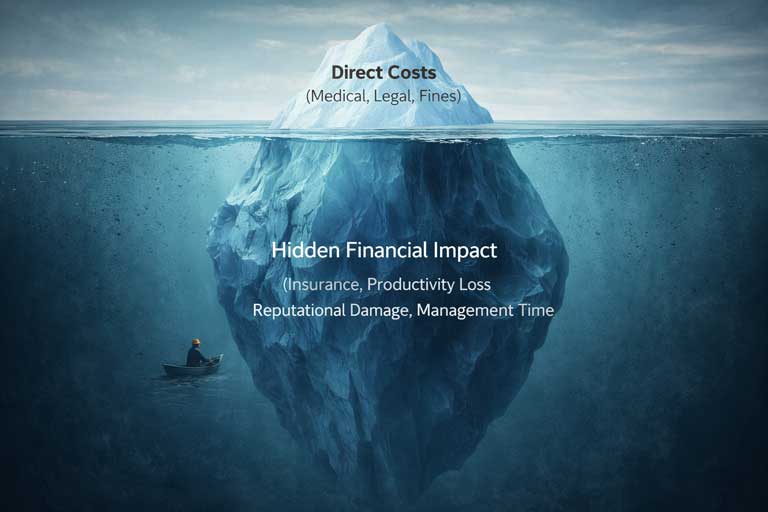
The Hidden Financial Impact of Poor Lone Worker Safety Management
Lone worker safety is often discussed as a regulatory obligation or a moral responsibility. What is far less visible is the financial exposure created when safety management is weak, inconsistent, or reactive. For many organisations, the true cost of lone worker incidents only becomes clear after a serious event forces attention onto insurance, staffing disruption, regulatory scrutiny, and unexpected budget pressure.
Poor lone worker safety management is not simply a risk to individuals. It is a persistent financial liability that accumulates quietly across operations, finance, insurance, and governance functions.
Lone Worker Safety Is Often Treated as a Compliance Issue, Not a Financial One
In many organisations, lone worker safety sits within compliance or WHS frameworks. Policies are documented, procedures are defined, and training is delivered. From a governance perspective, this can create a sense that risk is controlled.
Financial exposure, however, does not respect organisational boundaries. When incidents occur, costs appear across multiple budgets, often months apart. Medical expenses, insurance premiums, legal review, management time, and workforce disruption are rarely consolidated into a single financial view. As a result, decision-makers underestimate both the scale and persistence of the cost.
Treating lone worker safety purely as a compliance exercise obscures its role as a financial risk driver.
Why the Financial Impact of Poor Safety Is Rarely Visible
The financial impact of safety failures is rarely captured in one place. Some costs appear immediately, while others surface gradually. Insurance premiums may rise long after an incident. Productivity losses may be absorbed informally. Management time spent responding to incidents is rarely quantified.
This fragmentation creates a visibility problem. Without a clear financial narrative, safety incidents are seen as isolated events rather than contributors to ongoing cost exposure. Over time, organisations accept these costs as operational noise rather than controllable risk.
Making Hidden Costs Visible Through Financial Signals
Even when incidents are infrequent, financial signals often appear earlier. Increased overtime following safety escalations, repeated rescheduling of lone worker tasks, rising incident response hours, and growing administrative overhead all point to underlying risk.
These signals matter because they allow organisations to identify cost exposure before a serious incident occurs. Visibility is not about counting incidents. It is about recognising patterns that indicate growing financial liability.
Direct Costs That Follow Lone Worker Incidents
The most visible costs following a lone worker incident are usually immediate. Emergency response, medical treatment, rehabilitation, compensation claims, legal advice, and regulatory penalties are often accounted for clearly.
While these costs can be substantial, they represent only part of the financial picture. Focusing solely on direct costs creates a false sense of containment, masking the longer-term financial consequences that follow.
The Cost of Near-Misses and “Almost Incidents”
Near-misses and minor incidents rarely trigger formal reporting, yet they impose repeated costs. Supervisors are pulled into investigations, work schedules are adjusted, and temporary controls are introduced. Each event creates small disruptions that compound over time.
Because these events do not appear in incident statistics, their financial impact is rarely tracked. However, repeated near-misses often indicate systemic weaknesses that eventually lead to more serious and costly incidents.
Equipment Damage, Vehicle Incidents, and Property Loss
Lone workers frequently operate vehicles, machinery, or critical infrastructure. Incidents can result in damaged equipment, vehicle downtime, third-party property damage, and service interruptions.
These costs are often treated separately from safety management, yet they stem from the same risk exposure. Repair delays, replacement costs, and operational downtime all contribute to financial loss beyond personal injury.
The Compounding Cost of Lost Productivity and Workforce Disruption
When lone worker incidents occur, productivity loss extends beyond the individual involved. Shifts must be covered, tasks rescheduled, and workloads redistributed. Teams may operate below capacity while investigations are conducted.
These disruptions rarely occur once. Over time, repeated incidents reduce throughput, strain remaining staff, and erode operational efficiency. The financial impact compounds as disruption becomes embedded in daily operations.
Response Time as a Financial Cost Multiplier
Response time plays a critical role in determining the severity and cost of incidents. Delayed response increases injury severity, extends recovery time, and expands the scope of investigations.
Faster response often limits both human harm and financial exposure. Poor visibility and delayed escalation increase downstream costs, turning manageable incidents into significant financial events.
Increased Insurance Premiums and Long-Term Risk Classification
Insurers assess risk based on incident history, response effectiveness, and ongoing safety controls. Poor lone worker safety performance influences premium increases, excess levels, and coverage conditions.
These changes affect financial planning over multiple years. Once an organisation is classified as higher risk, reversing that position can take significant time and sustained investment.
Management Time and Operational Distraction as a Financial Cost
Senior leaders, managers, and supervisors are drawn into incident response, reporting, insurer engagement, and remediation planning. This time is rarely costed, yet it represents a direct financial loss through opportunity cost.
Operational focus shifts from growth and efficiency to damage control. Over time, this distraction becomes a recurring cost rather than a one-off event.
The Cost of Informal Safety Workarounds
In the absence of effective safety systems, teams create informal workarounds. Extra check-ins, manual supervision, duplicated reporting, and ad hoc controls become routine.
While these measures are well-intentioned, they add overhead, reduce efficiency, and introduce inconsistency. Informal workarounds are expensive precisely because they are unstructured and difficult to scale.
Reputational and Contractual Risk in Safety-Critical Industries
In industries where safety performance is scrutinised, incidents affect trust and credibility. Clients may question reliability, and partners may reassess risk exposure.
Reputational damage carries financial consequences through lost opportunities, reduced contract scope, or increased oversight requirements.
Procurement and Tender Disqualification Risk
Many procurement processes require demonstrated safety performance. Poor incident history or inadequate safety controls can disqualify organisations from tenders or preferred supplier lists.
In some cases, contracts include termination clauses linked to safety failures. These risks create financial exposure that extends far beyond individual incidents.
Regulatory Scrutiny and Ongoing Compliance Costs
A serious incident often triggers regulatory review, audits, and ongoing reporting obligations. Compliance costs increase as additional controls are imposed and monitored.
These obligations persist long after the initial event, increasing administrative burden and operational cost.
Psychological Safety, Staff Retention, and Recruitment Costs
Perceived safety risk affects retention and recruitment. High turnover increases hiring and training costs while reducing operational stability.
Loss of experienced staff also reduces productivity and increases the likelihood of future incidents, reinforcing a costly cycle.
Why Reactive Safety Management Is More Expensive Than Prevention
Reactive safety management focuses on response rather than control. Each incident generates cost, disruption, and risk exposure that could have been reduced through earlier intervention.
Preventive investment is not about eliminating all risk. It is about containing financial exposure before it escalates.
How Poor Visibility Increases Financial Exposure Over Time
Without real-time visibility, organisations respond late. Delayed response increases severity, cost, and regulatory attention. Repeated incidents become normalised rather than addressed.
Over time, poor visibility transforms isolated events into sustained financial leakage.
Using Lone Worker Safety Systems as Financial Risk Controls
Effective safety systems provide monitoring, escalation, and response capabilities that reduce severity and cost. They support faster intervention, consistent response, and better data for financial decision-making.
When viewed through a financial lens, safety systems function as risk controls rather than operational overhead.
Forecasting Lone Worker Safety Risk as Financial Exposure
Lone worker risk can be forecasted. By identifying high-risk roles, estimating incident likelihood ranges, and categorising cost types, organisations can model exposure before incidents occur.
This approach allows safety investment to be evaluated alongside other financial risks rather than treated as an unpredictable expense.
Aligning Lone Worker Safety With Enterprise Risk and Financial Governance
Lone worker safety should sit within broader enterprise risk frameworks. Aligning safety management with insurance strategy, financial governance, and operational planning ensures accountability and consistency.
When safety is treated as financial risk management, organisations gain greater control over both human and financial outcomes.
FAQs
Q1: Why are the financial costs of lone worker incidents often underestimated?
A1: Because costs are spread across multiple departments and timeframes, making them difficult to consolidate or forecast.
Q2: Which industries face the highest hidden financial risk from poor lone worker safety?
A2: Utilities, healthcare, construction, government services, and any sector with remote or field-based roles face elevated exposure.
Q3: How do near-miss events contribute to long-term financial exposure?
A3: They create repeated disruption, management overhead, and operational inefficiency, often signalling deeper systemic risk.
Q4: How does response time influence the total cost of a lone worker incident?
A4: Faster response reduces injury severity, recovery time, investigation scope, and downstream financial impact.
Q5: Can proactive lone worker monitoring reduce overall business costs?
A5: Yes. Proactive monitoring improves response speed, reduces severity, and limits compounding financial exposure.
Q6: How can finance teams estimate lone worker risk exposure before a serious incident occurs?
A6: By mapping high-risk roles, categorising potential costs, tracking early financial signals, and modelling likely scenarios.