



Balancing Human Oversight and AI in Australian Customer Service
Artificial intelligence is now a common feature of customer service operations across Australia. From automated call routing and chatbots to sentiment analysis and decision support tools, AI is being adopted to manage growing demand while controlling costs. This shift is particularly visible in outsourced customer services, where AI is often used to support higher call volumes and extend service availability without compromising response times. Yet as these technologies become more capable, many organisations are discovering that efficiency gains alone are not enough. Without proper human oversight, AI can introduce new risks that undermine service quality, trust, and accountability.
For Australian businesses, the challenge is not whether to use AI, but how to balance automation with human judgement. Customer service sits at the intersection of technology, regulation, and human expectation. Getting that balance right is essential for sustainable service delivery.
Why AI Adoption in Customer Service Is Accelerating
AI adoption in customer service is largely driven by practical pressures rather than innovation for its own sake. Call volumes continue to rise, customer expectations for speed are increasing, and businesses are under constant pressure to do more with limited resources. AI offers a way to absorb routine demand and provide consistent responses at scale.
Many organisations adopt AI to address specific operational issues, such as long wait times, uneven service quality, or limited after-hours coverage. In these contexts, AI is often introduced incrementally rather than as a full transformation. The problem arises when automation expands faster than governance, leaving gaps in oversight and accountability.
Where AI Adds Value Without Compromising Service Quality
When applied carefully, AI can enhance customer service without diminishing the customer experience. It performs best in areas where consistency, speed, and pattern recognition matter more than judgement or empathy. These functions support human teams rather than replacing them.
Common areas where AI adds value include:
- Call and message triage based on intent
- Automated routing to the correct team or skill set
- Handling simple, repeatable enquiries
- Identifying trends or anomalies in service data
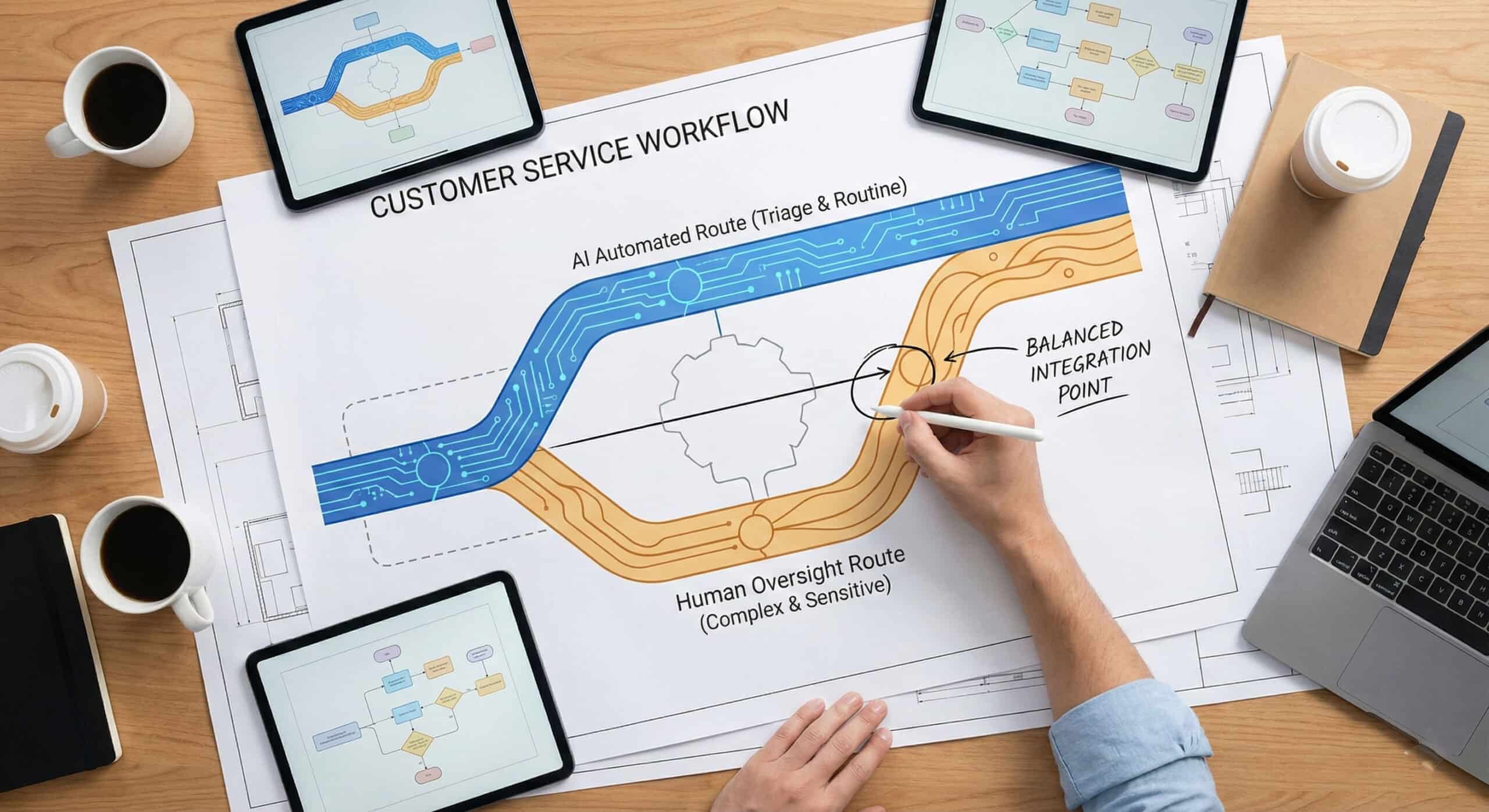
By taking on these tasks, AI allows human agents to focus on complex or sensitive interactions where judgement and context are critical.
The Risks of Over-Automation Without Human Oversight
Problems emerge when AI systems are given too much autonomy without appropriate supervision. Automated tools can misinterpret intent, apply rules too rigidly, or fail to recognise when a situation requires escalation. In customer service, these failures often surface as frustration, repeated contact, or complaints.
Over-automation can also obscure accountability. When a customer receives an incorrect response or experiences poor service, responsibility can become unclear if decisions are driven by systems rather than people. This lack of clarity is particularly risky in regulated industries or situations involving vulnerable customers.
Understanding Human Oversight in Customer Service Operations
Human oversight does not mean manually approving every AI-driven action. Instead, it refers to structured supervision that ensures AI operates within defined boundaries. This includes setting thresholds for escalation, reviewing outcomes, and intervening when systems behave unexpectedly.
In practice, human oversight involves supervisors, team leaders, and quality assurance processes that monitor AI-supported interactions. These roles ensure that automation aligns with service standards and organisational values, rather than drifting toward purely efficiency-driven outcomes.
Accountability and Decision Ownership in AI-Assisted Service Models
Accountability must always rest with people, not systems. Even when AI influences routing, prioritisation, or suggested responses, the organisation remains responsible for the outcome. Clear ownership ensures that issues can be addressed, corrected, and learned from.
Effective AI-assisted service models define who is responsible for system configuration, monitoring, and escalation decisions. This clarity is essential when dealing with complaints, audits, or regulatory scrutiny, as it demonstrates that AI is being used responsibly rather than blindly.
Australian Compliance and Regulatory Considerations
Australian customer service operations are subject to privacy, consumer protection, and transparency obligations. AI does not change these requirements. If anything, it heightens the need for careful governance, particularly when systems collect, analyse, or act on personal information.
Businesses must ensure that AI-supported interactions comply with privacy laws, consent requirements for call recording, and expectations around fair treatment. Customers should not be disadvantaged or misled by automated processes, and there must always be a clear path to human support when required.
Maintaining Customer Trust in AI-Supported Interactions
Trust is central to customer service, and AI can either support or undermine it. Customers are generally comfortable with automation when it is transparent, effective, and optional. Problems arise when AI feels opaque or obstructive.
Clear communication about when AI is involved, combined with easy access to human assistance, helps maintain confidence. Customers want reassurance that complex or sensitive issues will be handled by someone who understands context and can exercise judgement.
Designing Balanced Service Models That Combine AI and People
Balanced service models deliberately combine automation with human involvement at the right points. Rather than designing workflows around technology capabilities alone, successful organisations design around customer needs and risk profiles.
These models typically ensure that AI handles volume and speed, while humans retain control over exceptions, escalations, and emotionally charged situations. This balance allows organisations to scale efficiently without sacrificing service integrity.
Training Teams to Work Alongside AI Tools
Human oversight depends on people understanding how AI tools work and where their limitations lie. Training should focus on interpretation rather than technical detail, enabling agents and supervisors to recognise when AI outputs should be questioned or overridden.
Teams need confidence to intervene, not deference to technology. This cultural aspect is often overlooked, yet it is critical to maintaining service quality as automation increases.
Monitoring Performance and Risk in AI-Enabled Customer Service
Ongoing monitoring is essential to ensure AI continues to perform as intended. Customer service environments change over time, and AI models can drift if not reviewed regularly. Performance monitoring should look beyond efficiency metrics to include quality, fairness, and customer sentiment.
Key monitoring activities include:
- Reviewing AI-driven interactions through quality assurance
- Tracking escalation rates and exceptions
- Analysing customer feedback and complaints
These insights help organisations adjust systems before small issues become systemic problems.
Why Balance Is a Long-Term Strategy, Not a One-Off Decision
Balancing human oversight and AI is not a single implementation task. It is an ongoing discipline that evolves alongside customer expectations, regulatory requirements, and technology capabilities. Organisations that treat balance as a strategic priority are better positioned to adapt without disruption.
As AI tools become more advanced, the need for thoughtful governance will only increase. Businesses that invest early in oversight frameworks will find it easier to scale responsibly.
Closing Summary
AI has an important role to play in modern Australian customer service, but it cannot replace human responsibility. The most effective service models recognise that technology and people serve different purposes. By maintaining strong human oversight, organisations can harness the benefits of AI while protecting trust, compliance, and accountability.
Balanced automation is not about slowing innovation. It is about ensuring that innovation supports sustainable, high-quality customer service.
FAQs
Q1: Does using AI in customer service mean fewer human agents are needed?
A1: AI can improve efficiency by handling routine tasks, but it does not eliminate the need for human agents. People remain essential for complex, sensitive, or judgement-based interactions.
Q2: How do businesses stay accountable when AI tools are involved?
A2: Accountability is maintained by assigning clear ownership for system design, monitoring, and escalation decisions. AI supports decisions, but responsibility remains with people.
Q3: Are Australian customers comfortable interacting with AI systems?
A3: Many customers accept AI when it is transparent and effective. Trust is maintained when customers can easily access human support when needed.
Q4: What types of interactions should always involve a human?
A4: Situations involving complaints, vulnerability, financial impact, or emotional sensitivity should always allow for human involvement.
Q5: How can businesses review and improve AI-supported service over time?
A5: Regular quality reviews, performance monitoring, and customer feedback analysis help ensure AI continues to support service goals rather than undermine them.