



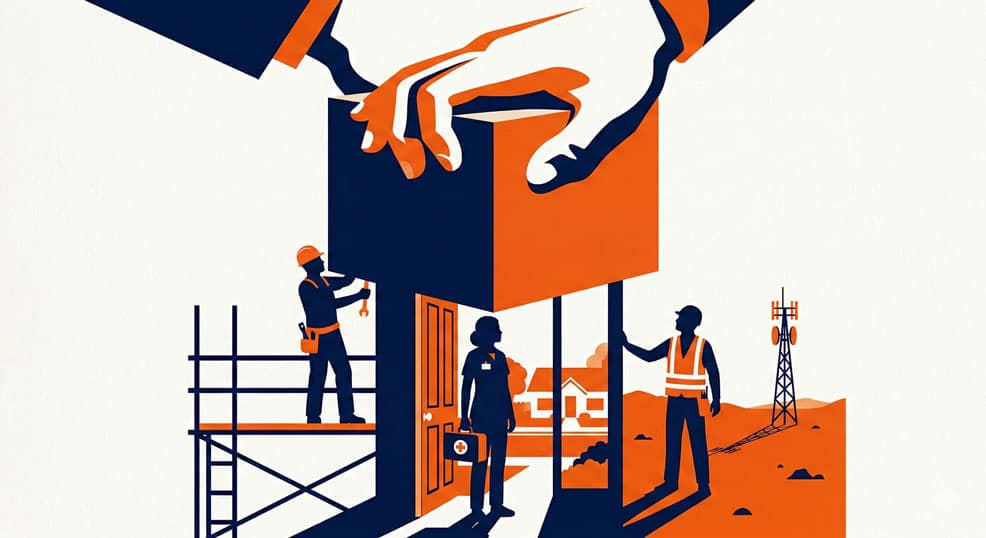
Why Generic Lone Worker Safety Models Fail Across Industries
Lone worker safety is frequently addressed through templated policies. Scheduled check ins, escalation lists and GPS tracking are applied uniformly across roles, with the assumption that risk exposure is broadly similar. Under Australian WHS legislation, however, risk controls must reflect actual exposure, not a generic category. The legal standard is not whether a policy exists, but whether controls are reasonably practicable given the environment, task and threat profile.
Organisations relying on structured national lone worker monitoring across Australia increasingly recognise that industry context determines risk. A field technician operating in remote Western Australia faces materially different hazards to a community health worker conducting home visits in suburban Sydney. Treating these roles as operationally identical creates blind spots that may only become visible after a serious incident.
Lone worker risk is contextual. Uniform safety frameworks often ignore that reality.
What Generic Lone Worker Safety Models Typically Include
Most standardised models contain similar elements. They are designed for administrative simplicity and rapid deployment rather than precision risk control.
Common features include:
- Fixed check in intervals
- Manual escalation through supervisor call lists
- Basic GPS tracking
- Post incident reporting processes
- Static emergency contact protocols
These controls are attractive because they are easy to implement and straightforward to document. During audits, they provide evidence of policy presence and procedural intent. In low exposure environments, they may appear sufficient.
The limitation is structural. These models assume consistency of exposure across all lone worker roles. They rarely distinguish between physical hazard, behavioural volatility, geographic isolation or communication reliability. As a result, organisations may achieve compliance visibility without achieving operational resilience.
Construction & Infrastructure Risk Profiles
Construction and infrastructure sectors demonstrate why uniform safety scripts fail. Workers may operate on partially developed sites, remote infrastructure corridors or regional projects hours from immediate assistance. Risks include heavy machinery interaction, working at heights, confined spaces and unstable terrain.
Environmental exposure compounds this risk. Heat stress in northern regions, bushfire conditions in summer, and severe weather in regional Australia create variable threat levels across different states and seasons.
In this environment, static check in intervals do little to mitigate sudden injury. A welfare call every two hours does not address the reality of high risk tasks occurring between those checkpoints. GPS tracking confirms location but does not guarantee timely escalation unless it is paired with active monitoring and defined response thresholds.
Construction exposure is dynamic. Tasks shift daily. Contractors rotate between sites. Risk levels change depending on activity allocation. A templated safety protocol does not account for this variability. Monitoring must align with task based risk, not simply job title.
Healthcare & Social Services Risk Profiles
Community healthcare workers and social services professionals face a different threat category. Their risk is often behavioural rather than environmental.
Home visits introduce unpredictability. Workers enter unfamiliar domestic environments and may engage with clients experiencing mental health crises, substance abuse issues or family conflict. The risk may escalate gradually through interaction rather than through a visible physical hazard.
Generic check in models do not detect emotional volatility or subtle distress indicators. When escalation relies entirely on worker initiated reporting, the organisation transfers the burden of risk assessment onto the employee during live engagement.
Under Australian WHS obligations, officers must exercise due diligence to ensure monitoring systems are effective and proportionate. A model that fails to distinguish between behavioural escalation and physical injury exposure may not meet the reasonably practicable threshold if an incident occurs.
Utilities & Field Service Risk Profiles
Utilities and field service technicians operate across geographically dispersed networks. Infrastructure inspections, underground access points and rural maintenance tasks introduce isolation risk.
Communication reliability cannot be assumed. Mobile coverage gaps remain common in regional and remote Australia. GPS signals may degrade below ground or inside industrial structures. Response distances can be significant, particularly outside metropolitan areas.
If escalation procedures depend solely on worker initiated alerts, distress may go undetected until after an event. Fixed check in intervals do not account for variable terrain, vehicle based isolation or extended travel distances.
Monitoring logic in these sectors must reflect geography, environmental exposure and communication reliability. Uniform escalation scripts rarely achieve that alignment.
Why Uniform Protocols Create Governance Exposure
The issue is not policy presence. It is risk alignment.
When monitoring triggers, escalation timing and response ownership are not calibrated to industry specific exposure, failure patterns emerge:
- Missed distress events due to static alert thresholds
- Delayed escalation caused by unclear response authority
- Over reliance on manual reporting
- Inconsistent audit documentation following incidents
After a serious event, regulators will examine whether monitoring controls reflected the actual working environment. Under Australian WHS frameworks, officers can be personally accountable if due diligence obligations are not met. The assessment focuses on proportionality and effectiveness, not administrative completeness.
A one size safety model may satisfy internal policy requirements while failing the external test of adequacy. This shifts risk from operational oversight to board level exposure.
What Industry Specific Lone Worker Monitoring Looks Like
An industry aligned framework begins with risk tiering. Roles are categorised based on task, environment and behavioural exposure rather than being grouped under a single “lone worker” label.
Effective models typically incorporate:
- Risk classification linked to specific tasks and environments
- Dynamic escalation triggers rather than fixed intervals
- Centralised monitoring oversight with defined response authority
- Documented audit trails supporting governance review
In construction, monitoring intensity may increase during high risk activities such as confined space work. In community services, silent duress activation and rapid supervisory escalation may be prioritised. In utilities, geographic mapping and response distance modelling influence escalation thresholds.
Monitoring in these environments is not simply device deployment. It is structured oversight. Escalation ownership is defined. Response protocols are documented. Governance reporting is embedded.
When monitoring aligns with operational reality, organisations strengthen both safety outcomes and defensibility under WHS obligations.
Financial and Reputational Consequences of Misalignment
Serious lone worker incidents trigger consequences beyond immediate injury.
Regulatory investigation may result in prosecution, enforceable undertakings or significant financial penalties under state based WHS legislation. Insurance premiums can increase following demonstrable control failures. In certain jurisdictions, industrial manslaughter provisions elevate executive exposure.
Operational disruption is equally material. Site shutdowns, service interruption, workforce morale decline and reputational damage can follow safety breaches.
For executive teams, lone worker safety is not an administrative function. It is a governance obligation. Controls must be proportionate, defensible and aligned to industry specific exposure.
Uniform models offer simplicity at implementation stage. They create complexity at the point of failure.
FAQs
Q1: Are scheduled check ins sufficient for most lone worker roles?
A1: Scheduled check ins may support low risk roles but are rarely sufficient for environments involving physical hazard, behavioural volatility or geographic isolation. Monitoring intensity should reflect actual exposure rather than a fixed timetable.
Q2: How do Australian WHS obligations apply to lone workers?
A2: Australian WHS legislation requires organisations to implement controls that are reasonably practicable given the identified risks. Officers must exercise due diligence to ensure monitoring systems are effective and proportionate to operational conditions.
Q3: Which industries face the highest lone worker risk exposure?
A3: Construction, utilities, community healthcare and social services often present elevated risk due to environmental hazard, isolation or unpredictable client interactions. Exposure varies by task and geography.
Q4: Does monitoring technology remove managerial responsibility?
A4: No. Technology supports oversight but does not replace accountability. Clear escalation ownership and documented response governance remain essential.
Q5: How often should lone worker risk frameworks be reviewed?
A5: Risk frameworks should be reviewed whenever operational conditions change, new roles are introduced or incidents occur. Regular review ensures monitoring remains aligned with evolving exposure and regulatory expectations.