



Managing Student Enquiries During Enrolment and Admissions Periods
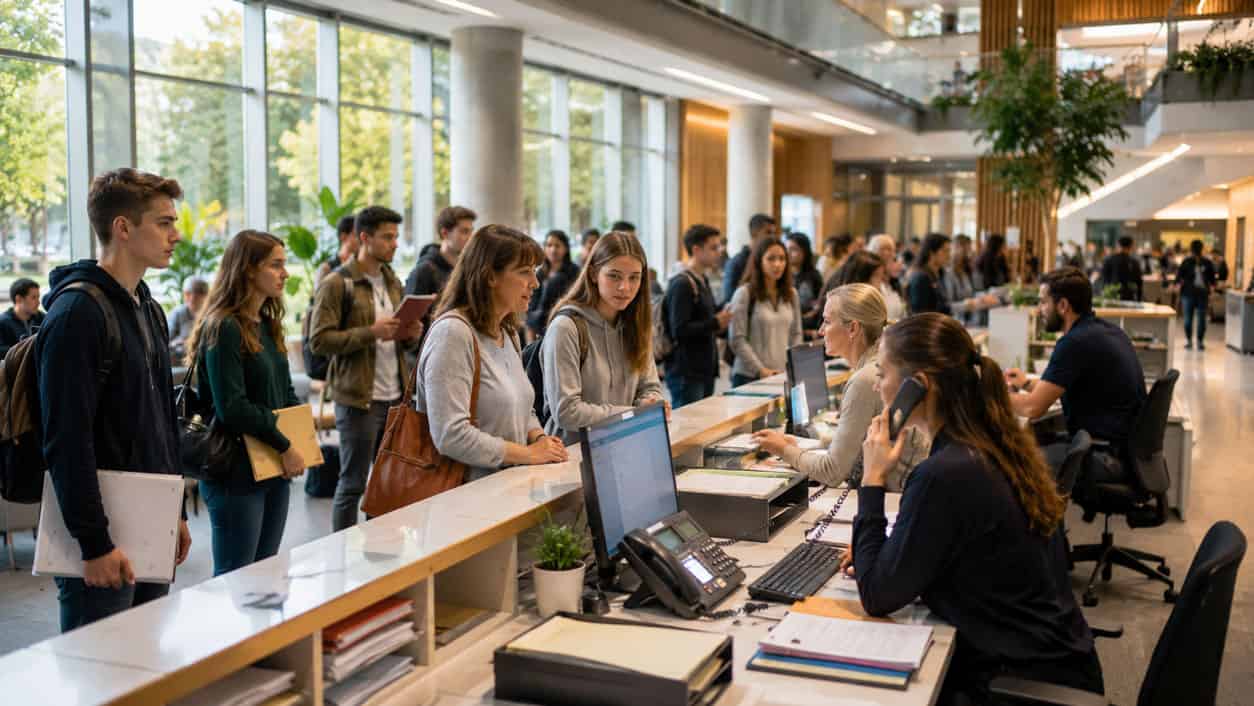
Every school, college, and training provider knows the drill – most of the year they get a reasonable level of enquiries, but then admissions season rolls around, offers are made, or enrolment deadline is approaching, and the number of questions becomes significantly larger overnight. Students and their parents need answers immediately, and often right as they are making up their mind, leaving no place for delays. That is why many educational organisations hire educational answering services to ensure fast responses during this period, since otherwise the team may be way too overwhelmed to cope.
Why Enrolment Periods Create Such a Sharp Spike in Enquiries
Enrolment and admissions seasons do not start slowly. They come in concentrated bursts that are always directly associated with certain dates of the academic year.
Application deadlines give one of the obvious reasons to expect a rush, as many students try to clarify all the issues before it’s too late. The date when offers are being sent is another good example of when the flood starts, as usually many people receive offers on the same day and need to ask questions about their acceptance or other opportunities. Course selection windows can become yet another trigger for a wave of questions, especially for institutions providing different courses and/or options.
When these dates happen to fall within the same weeks and trigger the flood at the same time, this is what makes the admissions periods so hard to plan for. The team prepared for the regular flow of calls may not be enough to handle several peaks coming one after another.
The Range of Enquiries Institutions Receive During These Periods
But the difficulty of such period management is not only in the volume of calls, but also in their diversity.
| Enquiry Type | Typical Example |
|---|---|
| Eligibility | Whether a student meets entry requirements for a course |
| Course details | Structure, duration, and delivery mode of a program |
| Fees and payment | Cost breakdowns, payment plans, refund conditions |
| Enrolment status | Confirmation of where an application currently sits |
| Document requirements | What needs to be submitted and by when |
Each category requires different information and sometimes even different level of details depending on how far along the student is in the process of deciding. The parent that wants to know about the fees requires a different answer to the student that asks if his transcript was received. Such combination can only be handled efficiently by the staff capable of moving from one enquiry to another quickly without escalating everything to a person of a higher rank.
Understanding Enquiry Patterns Across the Admissions Calendar
Identifying the time periods of peaks and preparing for them in advance plays a very important role in coping with the situation.
Call volume tracking in previous admission periods provides quite accurate estimation of when spikes in call volumes can be expected. Though the level of the peak might differ, the general period is clear enough. The dates of offer release are always known and that means that the spike can be easily predicted. Same thing goes for application deadlines when volume of calls increases gradually before the deadline.
It means that one can plan the resources needed ahead of time rather than dealing with long queues that appeared because of lack of preparation. Estimation of historical data with slight adjustment to the current schedule proves to be much more efficient that guessing.
The Risk of Under-Resourcing During Peak Periods
Misjudging the call peak periods has serious consequences.
When prospective students are comparing institutions as part of their decision process, this means there is an opportunity for a competing institution to respond to them before you do. Delays in answering an enquiry not only increase your reaction time but can influence where a student finally enrols. When a family experiences the enrolment process for the first time, with school-age children, they may have less patience for delays than a returning student who is aware of the system.
There is also an effect that increases the problem of unanswerable enquiries, as unresponded ones very seldom vanish in thin air. They are likely to become repeated, thus adding additional workload to the already overloaded team, making the problem even bigger, not smaller.
Practical Approaches to Managing Peak Enquiry Volumes
A couple of methods seem to be most effective after recognising a particular time period as a peak.
Increasing office hours during busy periods helps catch those inquiries which arrive after standard working hours, such as contacts of families in the evening after work and schooling. Using flexible or casual staffing allows increasing capacity just for the period of a peak, not spending on that the whole year round.
Self-service option may help to catch quite a number of routine queries, such as information about deadlines, payments or general course info, giving staff an opportunity to concentrate on more complicated or sensitive issues. For institutions lacking the necessary capacity for quick scaling, outsourcing seems to be an efficient solution. Many of the ideas related to dealing with sudden surge of demand in enquiries are also relevant in this case, as the problem itself is almost the same – short period of sharp increase of demand.
Preparing for Next Year’s Enrolment Period
The time to prepare for the next admission cycle is at the tail-end of the current one when things are still fresh in mind and not several months down the line and half-remembered.
Examining what actually occurred last year – which response times were slow, which type of enquiries caused delays, and how accurate was the volume of inquiries compared to expectations – is much more realistic for planning the next year than beginning entirely anew. Organisations that regard this process as an ongoing cycle, rather than something that comes to a frenzied peak a few weeks prior to the next peak period, find that their handling of the cycle is slightly better each time.
FAQ’s
Q1: At what points during admissions season do volumes of student enquiries reach a peak?
A1: Peak volumes occur around application deadlines and release of offers but vary based on the organisation’s academic calendar.
Q2: How many weeks in advance should organisations begin preparing for peak periods?
A2: Most organisations begin the review of resources required six to eight weeks before a known peak.
Q3: Can outsourcing be considered an option for schools/universities, too?
A3: Indeed, outsourcing can be used by institutions of all sizes, since the core advantage is additional resource allocation during a set peak period rather than a long-term increase in staffing.
Q4: What approach do institutions take when queries are received outside office hours at peak times?
A4: Coverage being extended during the busiest weeks, or using an answering service to receive queries during non-business hours, is an approach that can help avoid a query backlog developing.
Q5: Do queries fall away sharply once offers have been sent out?
A5: Queries tend not to go away but may just change focus to cover topics like enrollment, fees, etc.